

Council confirms sidewalks for Manor Park project
Construction project for six local roads to continue throughout summer
Ottawa City Council has voted to include sidewalks in the Manor Park integrated renewal project.
The final decision, at the April 8 meeting, brought an end to the protracted debate that has divided the community for more than a year.
The issue focuses on the local infrastructure project currently underway on Jeffrey Avenue, Finter Street, and parts of Kilbarry Crescent, Farnham Crescent, Arundel Avenue, and Braemar Street. The work involves:
• excavation of the entire width of the roads,
• separating combined sewers into sanitary and storm,
• replacing old watermains,
• repaving the roads with curbs and sidewalks on one side (no sidewalks for Finter and the Farnham cul-de-sac).
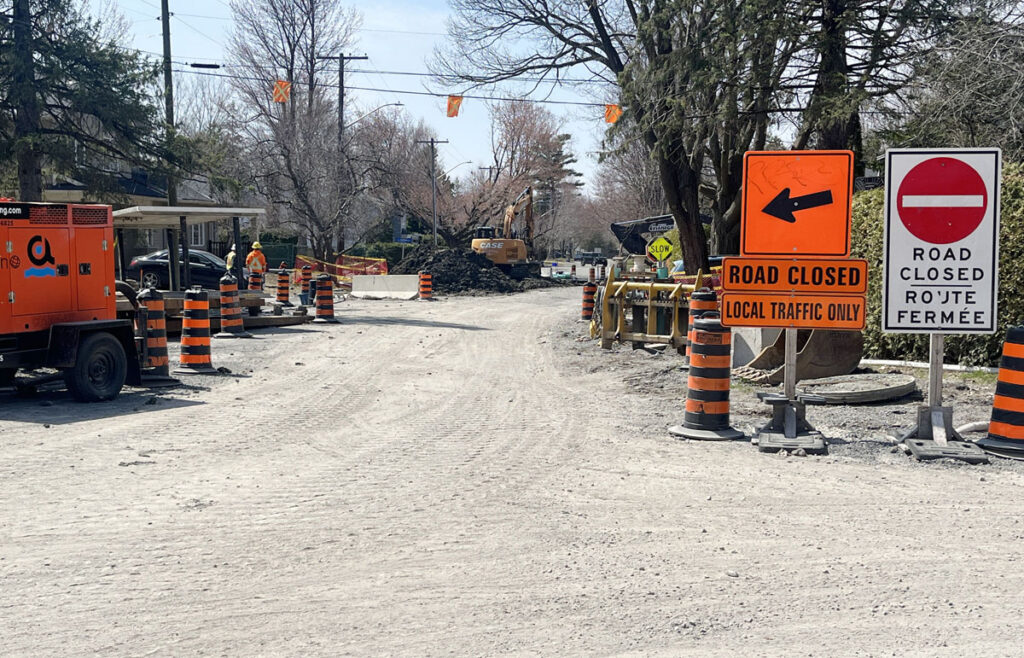
When the project was announced in the fall of 2024, affected residents sought to block the inclusion of sidewalks. But city policy (Transportation Master Plan and Official Plan) dictates all such infrastructure renewal projects must add sidewalks and curbs.
Committee meeting
The issue came to a head, first at the March 30 Public Works and Infrastructure Committee (PWIC) meeting, then at full city council a week later.
The committee meeting opened with 18 delegations from the public (see separate article with quotes from the presentations).
Following these, Rideau-Rockcliffe councillor Rawlson King sought a deferral for the $180,000 project sidewalks as part of the city’s Road Modification Agreement (RMA) process. He read several motions, one of which sought the delay in order to have staff conduct a detailed study on the impacts future development and transportation projects could have on Manor Park.
Another motion asked to have staff reallocate funds from the project, or find other funding sources, in order to place sidewalks where they would be more useful — around Manor Park Public School on Eastbourne, Thornwood and Braemar for example.
Both motions were defeated by a vote of 7-5.
Two other motions brought by King were approved, however.
One corrected errors and omissions in the staff report presented to the committee. The other directed staff “to develop a scoped work plan and resource estimate for a neighbourhood-level transportation assessment for the Manor Park community, encompassing traffic projections, pedestrian and cycling demand, cumulative impacts of all planned transportation changes, and a prioritized pedestrian infrastructure investment plan.” Staff are to report back to committee by Q4 of this year, according to the motion.
“I think it’s important, with all the changes, if we’re serious about the holistic impacts of the transportation changes as well as the potential land-use changes, we need to be able to examine that, I think, in a neighbourhood-wide context,” King told the Chronicle in a subsequent interview.
“So, despite the fact the sidewalks are being implemented, the reality is that there is the prospect of some transportation study work being undertaken in the community which I think is a very important element that needs to be examined.”
At committee, King said Manor Park is facing more changes to its transportation infrastructure in the next 10-15 years than it has seen in the past 50. The opening of Hemlock Road to Wateridge Village and potentially 10,000 residents “will introduce an entirely new traffic corridor into the heart of the community,” King said.
Then there’s the proposed traffic circle at Braemar, Eastbourne and Ava, as well as the potential rebuild of Beechwood Avenue.
“These are coming,” he said.
Council meeting
At the council meeting on April 8, the motion introduced by King was a modified version of the one he had brought forward the week before at committee.
“My motion at council really reflected the analysis from the city’s own prioritization criteria which focused on maintaining sidewalks where the city determined that they added real value and reconsidering those where the network value is limited,” he told the Chronicle.
Sidewalks would proceed on Kilbarry north of Arundel, Arundel east of Kilbarry, Jeffrey and Braemar. They would be removed for Kilbarry south of Arundel and Arundel west of Kilbarry.
Most councillors around the table refused to support King’s motion. It was defeated by a 16-7 vote. Several noted providing an exception would set a potential precedent for other city neighbourhoods earmarked for integrated projects. It would also send the wrong message regarding promoting accessibility and pedestrian safety.
Still, many agreed with King there should be more flexibility in how sidewalks are being built to ensure sequencing is done more effectively.
While his own motion was defeated, he supported a second motion from councillor Laine Johnson. It calls on staff to review how it implements city policy for new sidewalk construction “across the TMP and integrated renewal program to improve accessibility, connectivity, and safety for pedestrians.” The staff report would be presented during the next council term.
Frustrations
The sidewalk debate created friction and frustration within the community.
Those in favour felt the city policy was in place for a reason and should not be altered. The benefits — safety, accessibility and connectivity — should far outweigh the desire to maintain the status quo. Those against argued the streets are actually safer as they are. Sidewalks, some noted, create a hindrance for those in wheelchairs or walkers and potential hazard for falling.
As explained at council, the sidewalks leading to the school are listed in the Transportation Master Plan but won’t be installed for another seven to 10 years. King says, unfortunately, funding for this project comes from a different treasury account. With the city facing “limited resources,” the work has to wait its turn on a city-wide priority list.
“I understand the frustration of residents when they say, ‘we’ve been advocating for more than a decade to have infrastructure around the school, we see the real problems there, and we don’t feel our advocacy is getting anywhere.’”
Silver lining
While the project sidewalks are going ahead without the studies, King says there is a silver lining in that the debate shone a light on some policy deficiencies.
Hopefully, a review of the RMA process will result in changes to allow more flexibility in how certain policies are carried out.
“The reality is we do have a process to renew and improve our infrastructure. I just don’t think that approach should be as mechanistic as it is,” King said. “You need to have flexibility in policies to ensure that they are the right fit for community members.
“What we were just saying is that we need to get the sequencing right. We need to actually study what we’re doing so that the neighbourhood that we start to build out is done right.”