

ON CALL:
Fire Station 57 crews dedicated to protecting local residents
They are firefighters, first and foremost. But after speaking with one of the crews of Ottawa Fire Station 57, it’s clear the job is so much more than that.
“You never know what the day’s going to bring,” says Capt. Tracey Fields. “Sometimes we get in (to the station) in the morning, we make a plan and it goes right out the window, depending on how the day goes.”
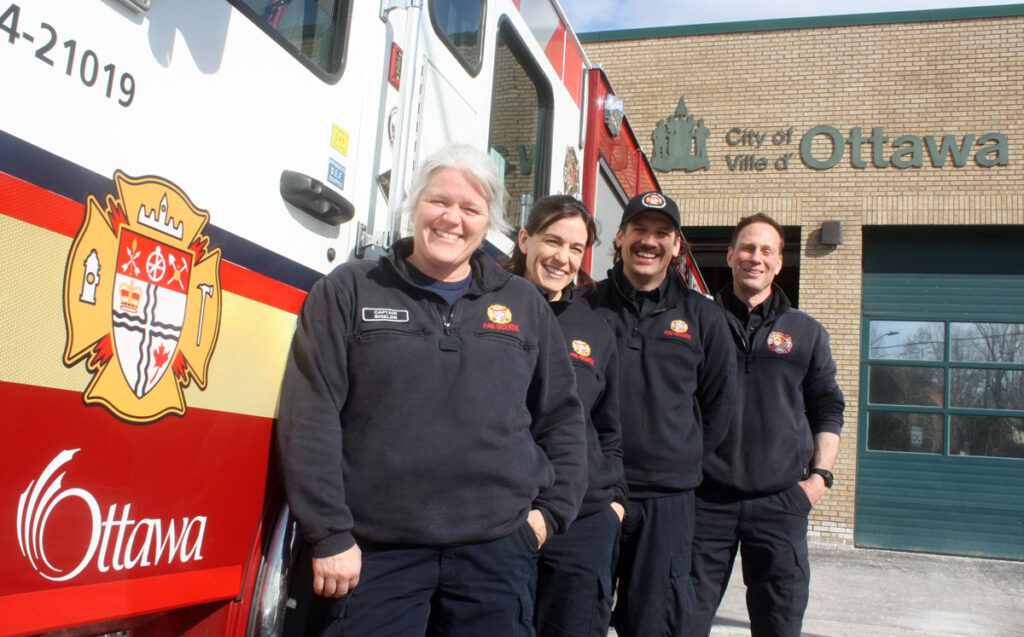
The 27-year veteran of Ottawa Fire Services (OFS), five years as captain, leads the four-member ‘D’ crew, one of four teams working out of the Beechwood Avenue location.
They work a 24-hour shift, from 7 a.m. to 7 a.m. Over that time, they will respond to an average of eight to 12 calls, traveling aboard the familiar P57 pump truck. If the call requires the ladder truck, additional staff is called in.
Those calls can range widely throughout the day, Fields explains. Fires, alarms (probably the most common), and medical situations top the list. “Medicals can be for a variety of different things — chest pain, someone breaking their leg, falling off a bike, things like that,” she says.
(On this day, the interview was delayed as the crew rushed to assist a pedestrian struck by a vehicle just two blocks from the station.)
Then there are motor vehicle collisions, elevator calls, gas leaks — the list goes on.
“When people don’t know who to call, they call us,” notes Laurence (Larry) Lemieux, an 11-and-a-half-year veteran of OFS.
“We went to a call last year for a fishing lure that got stuck in the lip of a cat, a kitten, so they called us to go,” Fields confirms.
While not their specialty, they have also attended hazmat calls and water rescues on MacKay Lake and the Rideau River. “We don’t generally get them but we’ve certainly been to four or five in the past year,” Fields says.
Coverage area
Station 57 covers an area that includes New Edinburgh, Rockcliffe Park, Manor Park and Vanier. Their district also stretches over the St. Patrick Street Bridge to Cobourg Street, the fire captain explains.
“We also back-up stations around us (Byward Market, Overbrook and Montreal Road). We help out with a larger district than just our own here.”
Alarm calls, for example, require two pumper trucks and a ladder. “So, for downtown in the market, their two trucks would go and then we would support them,” Fields says.
False alarms are an ongoing issue that could result in fines for landlords who don’t maintain their systems. “It’s ( City of Ottawa by-law) really for the repeat offenders.”
The new regulations, introduced in 2024, have had the desired effect.
“We were going to a couple of buildings very regularly. Now they’ve been fined and … they sorted themselves out,” Fields says.
Life in the firehouse
Life at the fire station is very much like a family.
“It’s mostly spent tolerating your colleagues,” firefighter Tim Bernardi says with a laugh. “We’re here 24 hours so we’re living together.”
A typical day, according to Fields, would start with a debrief with the previous crew. A check of the pumper truck and all equipment follows.
“I usually check the training calendar and what we’re required to do for the day. Then we have a meeting, have a coffee, and talk about the day, what we want to do and what we have to do.”
The crew makes various stops throughout the district, “especially if there’s been construction going on or road closures,” Bernardi says.
“So, we try to get out in the district regularly, every shift, and check out a different area, to see what’s going on,” Fields adds.
Returning from a call, especially one requiring the hose, requires a significant clean-up, which can take from 60 to 90 minutes.
“We have a big tower in the back where we hang it (hose) to dry. Then we have a spare hose … we put on the truck,” she explains. “But all of our gear, all of our packs, everything has to be cleaned after a fire … just trying to keep the contaminants out of the truck, so we wash everything after.”
Shift cycle
Ottawa firefighters work off a 28-day cycle, Lemieux explains.
“Within 28 days, we work seven (24-hour) shifts, which actually equates to 42 hours of work per week,” she says.
And those shifts occur in clusters, with five of the shifts within a 12-day period. The crew gets along well, Bernardi jokes, but by the end of that fifth shift, “We’ve had enough of each other.” He then says with a smile, “It’s good. We have lots of fun.”
Serious training
Firefighter training takes place daily.
“It could be a matter of taking the truck out and flowing some water through it or taking the ladder truck out and setting it up, going through scenarios on the computer or reviewing our policies,” Fields explains.
The crews also undergo regular medical training as well as training to refresh skills that may not be used on a daily basis — if ever.
“Let’s say, rescuing a firefighter in a burning building,” Lemieux says, noting it’s an occurrence they hope never happens but are well prepared to handle.
Backgrounds
Crew 57D is certainly not short on experience.
Fields was one of the first three female firefighters hired by the service 27 years ago. She is also Ottawa’s first female fire captain.
“For me it’s just my life, it’s who I am,” she says. “I don’t think I did anything special or different than anybody else. But I do think representation is important. I think it’s important for other young women and young boys to see it.”
The number of women in OFS continues to climb slowly, Fields notes.
“It’s growing for sure. We were at three or four per cent for many years and now I think we’re up to six or seven per cent,” she says. “It’s still not a lot but it’s certainly more than it was.”
Female firefighters bring a different perspective to the position, not just due to gender but through different life experiences, she says.
“All the experience everybody brings makes the team better,” according to Fields.
Bernardi, who has nine years with OFS under his belt as well as years of volunteer service in Thunder Bay before that, takes it one step further.
“It may sound hokey but our diversity is our strength,” he says. “We’ve got electricians on the job (including fellow crew member Chris Lee, a five-year OFS veteran). We have people who are able to speak multiple languages and, in an area like this that’s bilingual and trilingual, that’s incredible.”
Then, with tongue planted firmly in cheek, he adds, “I still haven’t figured out what I bring,” sparking laughter around the table.
“You just never know what kind of a call you’re walking into so I think having a variety of diverse backgrounds and experiences just makes sense,” Fields adds.
Highlights
Asked for a highlight of their time with the service, they all come to the same conclusion — it’s the people.
“It doesn’t matter where you go or what station you’re in, or what shift you’re on, firefighters are all generally really good people,” Fields says. “The people are really what it’s all about. We’re lucky to come to work every day.”
Lemieux adds she appreciates the opportunity to see the city from a different perspective and make a difference in people’s lives.
Of course, getting to drive the truck is pretty cool too, they admit.
Their work may not always be wall-to-wall excitement, as often portrayed in movies or on TV. But it’s reassuring to know these dedicated individuals are on duty. And they’re ready to help all those in our community who find themselves in a vulnerable situation.