

Tiny Forest takes root in Manor Park
Tree planting project involved entire school community in fall 2025
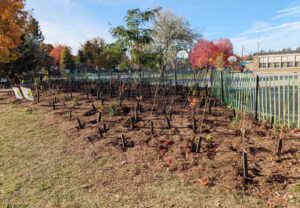
They say good things come in small packages. How about the gift of a Tiny Forest — like the one at Manor Park Public School (MPPS)?
The special tree planting project took place in the fall of 2025, a coordinated effort led by Forêt Capitale Forest (FCF) and EnviroCentre. Both local non-profit organizations are focused on taking concrete action on climate change.
The program, explains Jodi Newman, Afforestation Program Manager with FCF, dates back to 2022. It has grown consistently across the region since then and has built strong partnerships along the way.
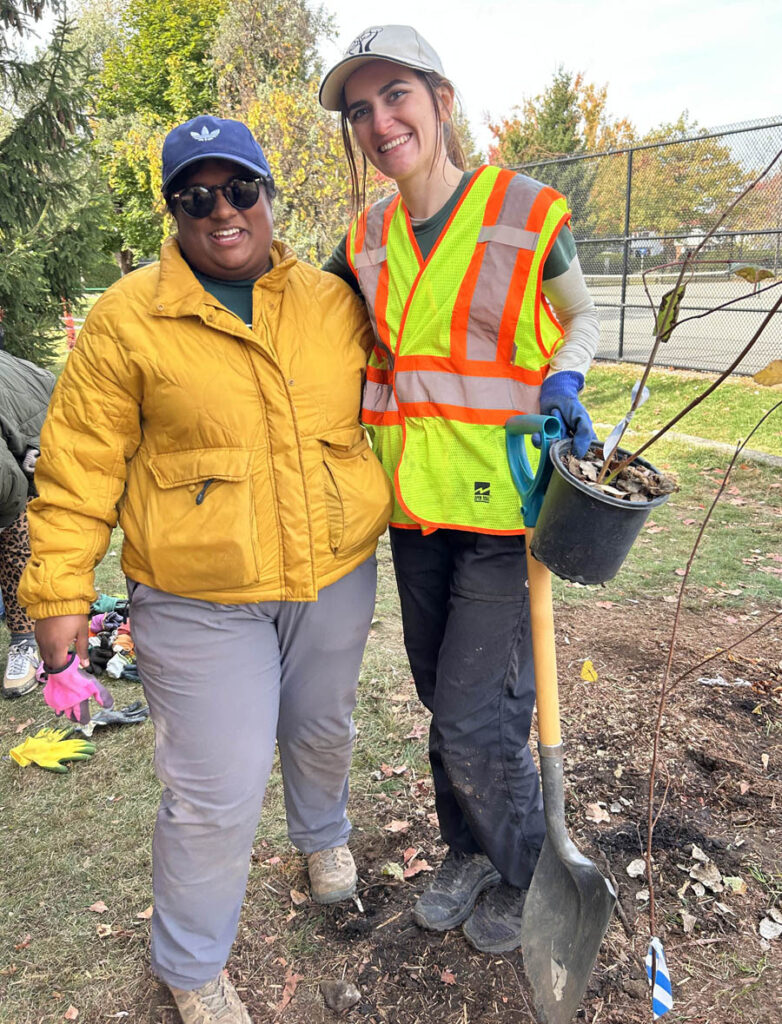
One of those partners is the Ottawa Carleton District School Board (OCDSB) which proposed MPPS as one of several potential Tiny Forest sites.
EnviroCentre project lead Stephanie Benoit says while the Manor Park plantings took place in October, work to prepare the site started months earlier. After choosing a location on the school property in the spring, they “amended the soil” over summer “by adding compost, mulch, and other organic matter and mixing it in a metre deep.”
Once school returned, they coordinated a planting day wth school faculty and staff. The goal was to involve as many students as possible in the project.
As things turned out, Newman says Manor Park was the largest school planting to date.
“We had 700 student volunteers come out throughout the day to plant and water! A handful of parent volunteers also helped out in shifts by giving direction and keeping all the kiddos in line. It was such a fun-filled day!”
Educational opportunity
Newman says the school projects are opportunities for students to learn the role these plantings can play in mitigating the negative effects of climate change.
“The majority of kids feel a lot of pride in what they are creating, and they often vow to remember which tree they planted so they can come back and take care of it,” she noted.
In all, there are 45 species in the Manor Park tiny forest, which is located behind the school near Hemlock Road. Newman says canopy trees, such as Basswood, Yellow Birch, and White Pine, “understory trees and shrubs” such as Chokecherry, Spicebush, and Highbush Cranberry, and forest floor perennials (Boreal Yarrow, Anise Hyssop, and Lanceleaf Coreopsis) were among those included that day.
“The goal with a tiny forest is to incorporate native species that compromise all layers of a natural forest, at a high planting density (three to five species per square metre),” Newman explained.
And the learning doesn’t stop on planting day. Newman says a teacher asked her questions in order to “incorporate the concepts of the planting into a biodiversity component of their science curriculum.
“Tiny Forests can help students connect theory to real world experiences,” she notes.
Forest monitoring
Monitoring of the trees is done by FCF and EnviroCentre staff, especially during the summer when school is out. During the school year, maintenance staff will often assist. Parent and student volunteers are also encouraged “if they are interested,” Newman says.
Benoit notes the work involves weeding, watering, and health checks. They also identify trees that need to be replaced and check for damage to the temporary fence.
The two non-profit organizations will continue to visit the site through the fall of 2028 “to ensure the tiny forest is establishing and thriving.”
With the proper care, the trees should grow as one would expect, Newman says. “The close proximity means they may grow taller a bit faster to compete for light, and the individual crowns may be a bit narrower than a standalone tree of the same species. But the canopy is expected to fully close within the first 10 years of growth, and the end result is a multi-layered planting.”
Support is growing
The local project was supported by the Josette Robertson and the Joan Johnson Family Foundation — a fund out of the Ottawa Community Foundation — as well as Trees for Life and the OCDSB. With the foundation’s support, Benoit says they expect to plant 12 more tiny forests over the next two years. There are already more than 20 across the city.
Newman notes FCF also launched ‘Tiny Forests Together’ last year. This program invites interested community groups to submit applications.
“We saw a lot of passion in community groups to plant tiny forests, but they often lacked the resources, funding, and industry expertise to be able to do them on their own. We planted one at Westboro Beach through this program, and have more coming in 2026 and 2027,” she explains.
While each individual tiny forest is small in size, their collective impact can be far greater.
“While they are just one piece of the puzzle of addressing climate change, each one builds momentum, strengthens community, and makes our cities more resilient,” Benoit explains. “The strong community advocacy behind Manor Park’s forest is proof of that. It’s been an incredibly rewarding project to be part of, and we look forward to watching it grow and thrive for years to come.”