

Ottawa Humane Society em-‘barks’ on ambitious project
Future vet clinic in Vanier will support pet owners who otherwise could not access care for their animals
It’s a dream scenario — a ‘local’ veterinary clinic established to assist vulnerable residents and their pets. But it will take strong community support to turn it into reality.
Earlier this spring, the Ottawa Humane Society (OHS) announced plans to branch out. The organization, headquartered at 245 West Hunt Club Road, purchased the former post office building at 258 Durocher Street in Vanier. The goal is to retrofit the structure for a vet clinic accessible to all pet owners, regardless of circumstance.
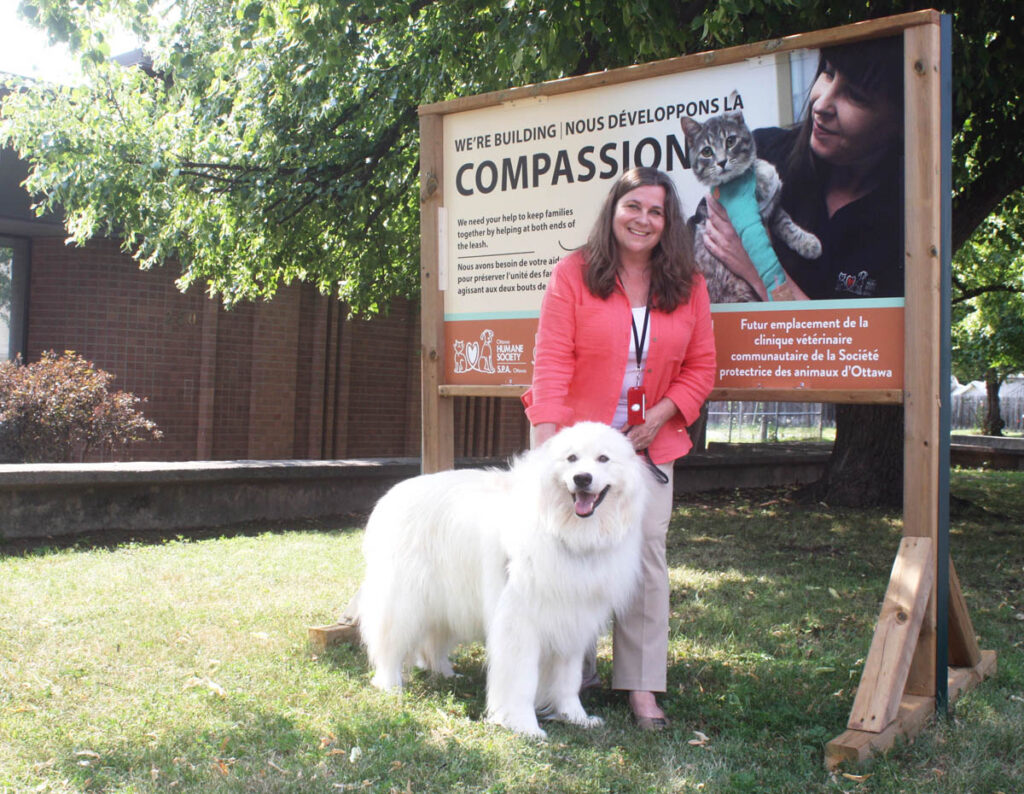
To make that happen, however, the public is being asked to step up in a big way. The OHS has launched a $15 million fundraiser — dubbed its ‘Compassion Campaign’ — inviting residents to help make a difference in their community.
“We’re so excited to have purchased this building but there’s still so much work to be done to turn it into the vet clinic it needs to be,” Sharon Miko, OHS president and CEO, told the Chronicle in a recent interview.
People are encouraged to visit the OHS website (www.ottawahumane.ca) for full details on ways to participate.
“We cannot bring this project to life without our community support. Little bits here and there, larger donations — we have naming opportunities for larger gifts — to be able to move forward and be able to buy everything that we need,” she said.
Beyond the building purchase and retrofitting, the list includes surgical equipment, x-ray, prep and surgical tables, microscopes and more.
“Everything that a vet clinic would have to be able to serve the animals that we’re going to be seeing.”
Timeline
Miko says the OHS is in the process of selecting a builder for the renovation work “and we anticipate that we’ll have designs ready by the end of the year.”
If all goes according to plan, that work would begin in early 2027 and be completed in time for an April 2028 clinic opening.
“We’ve been very careful with our planning to ensure that this seems to be a realistic time frame.”
Currently, the 9,000-plus square-foot building is an open space, a blank canvas from which to work. The CEO estimates two-thirds of the area will be used for the clinics. The remainder will house other services such as pet food bank, small retail and training spaces.
“It is not going to be a state-of-the-art and super high-end clinic. We have to look at ensuring that we have the bare basics to be able to do the best for the most. Our money is really being put into helping more animals, that is our goal.”
The clinic’s location is ideal, Miko says, for reaching as many people as possible.
“… When we looked at demographics, there is a higher density of population here, it’s more central, and it’s an area that’s more easily accessible. So we’re seeing a need for service in this area but also in an area that is able to service the rest of the city.”
Services
The clinic will take a “walk before we run” approach, with appointments Monday to Friday to start.
The focus will be on such things as pet sterilization (to help with the cat overpopulation) and microchipping. Too often, pets are brought into the shelter without proper identification, Miko says. “Sadly, we’re often not able to return those animals to the owner because there is just a lag between the time someone realizes an animal is missing and makes efforts to try to find it.”
Wellness visits will be another service offered at the clinic, allowing families to have their pet checked on a more regular basis. Miko says it’s “absolutely heartbreaking” when an animal is brought in with a chronic health condition that could have been prevented with earlier intervention.
Emergency service will not be provided but there will be some day surgeries.
And end-of-life appointments will also be available. Currently, a pet owner can surrender their pet to the shelter with a request for euthanasia but can’t be with the animal. “What we really want to create here is a service where we can ensure every animal has access to end-of-life services when they need it.”
Cost
The cost of services will depend on a pet owner’s economic status, Miko explains.
The OHS developed a successful income qualifying service when it ran its mobile program a decade ago.
“Based on the guideline that we set, for example we will be offering sterilization (available to the general public) at a rate that will still be competitive but that accessible rate will be available to everybody in the community. However, we will offer a lower rate for income-qualified population.”
Other services, such as wellness visits, will be limited to those who qualify for a lower rate “because these are individuals who otherwise would not have access to veterinary care.”
Big step
Miko says this is a big step for the OHS and an important one for the community.
“We’re not going to be everything for everybody … but our goal is really to elevate animal welfare in Ottawa by ensuring that animals are receiving the support they need to be taken care of, to be free from pain, free from injury or disease — and have good lives.”
She remains optimistic the fundraising goal will be met.
“What separates us from a lot of charities, is that so many people have pets,” she said. “We know that Ottawa supports this project. We’ve got some tremendous opportunities for people to demonstrate that commitment and to help us make sure we do more for animals.”