

GOOD DOG: Socialization/habituation and humane treatment
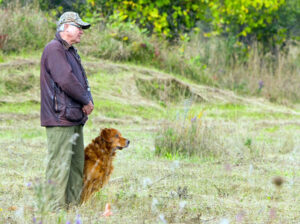
By way of introduction to readers who have recently joined us, Good Dog is founded on three key precepts: human beings are fortunate to have such a cooperative and sociable species as our canine companions; domestic dogs have proven themselves very capable of high levels of good behaviour, obedience and companionship; and, with a little guidance, well-motivated dog owners can bring out the true nature of their dogs.
Readers can find Good Dog column online at: https://manorparkchronicle.com/
In the previous issue of the Manor Park Chronicle, we introduced readers to most of the major elements of a training framework. We identified common handling practices to avoid, and concluded with a discussion on basic care, housing and training equipment. In this column, we elaborate further on the training framework, introducing the importance of socialization/habituation and humane treatment.
Training Framework: Socialization/Habituation & Humane Treatment
So far, we have established that leadership, obedience, behavior, human-dog bond and communication are key elements of a comprehensive canine training framework. But there are two additional and equally important elements of this framework to introduce, namely, socialization/habituation and humane treatment.
Socialization/Habituation: Socialization refers to familiarizing your dog with the living world and habituation refers to familiarizing your dog with their physical environment.
The strategies and tactics for your dogs’ socialization with humans, cats, other dogs, etc., differ immensely from those called upon to habituate your dog with households, kennels, water, vehicles, travel crates and so on. What links socialization and habituation training is the role each plays in helping prevent, manage and overcome fear and insecurity in social and other circumstances.
A lot depends, of course, on the age and breeding of your dog. Selecting a pup from well-socialized parents, one with good eye contact, is comfortable around humans, enjoys physical contact, and joins its littermates in the daily scrabble for mom’s attention, goes a long way to ensuring a confident and outgoing mature dog. At the same time, fear and anxiety shown by an adolescent or mature dog is much easier to manage if the dog is well-trained. Here, solid obedience can, with repetition, overcome negative stimulus. But as we will see in the upcoming Good Dog column, capitalizing on that brief dog socialization/habituation window, very early in their relatively short lifespan, is a training opportunity. If missed, it adds significantly to the challenge of raising a confident, obedient, safe and outgoing dog.
Humane Treatment of Dogs: Earlier we introduced the principles of “firm”, “fair” and “friendly” as the core of our training approach. But what do these three words mean when it comes to humane dog training? We know that dog owners who are too heavy-handed in the treatment of their dogs are as bound to fail, as are those who ignore their responsibilities as pack leader. Both extremes create fear and confusion on the part of the dog and diminish the quality of the human-dog bond.
Lending credit to this analysis, in Let Dogs Be Dogs (2017) the Monks of New Skete observe:
• harsh compulsion training and bullying a dog into submission is not artful dog training;
• positive training, alone, cannot correct bad behavior; and
• ignoring problem behavior will not cause it to go away.
They conclude there must be an appropriate amount of discipline in any healthy relationship between owner and dog. By way of solutions, they offer a compelling argument for a balanced, compassionate and authoritative approach. This combines guidance, positive encouragement and rewards. Following this approach, once having been taught a command the dog should be held accountable for compliance. This calls for firm physical corrections only when the dog ignores what it has been taught and understood.
This is at the heart of what constitutes the humane training of dogs, a well-considered approach that serves as a foundation for the training of a decent companion dog to the mutual benefit of dog and owner alike. To do otherwise is to fail to prevent the behavior and temperament problems that will inevitably arise. As my friend and dog training mentor, Mike Ducross, would say “To train is to create. But, equally important, it is to prevent.”
Conclusion
As the author Desmond Morris (Dogwatching, 1986) so eloquently put it, man’s best friend is simply a wolf in dog’s clothing.
In our next column we will consider how a better understanding of the origins of the domestic dog, and of their development from puppy to adulthood, can help guide our training and improve training outcomes. In subsequent columns, we will start exploring the fundamental working strategies for all seven elements of our training framework. In the meantime, below is a training tip you may wish to practice with your dog.
Until the next issue of the Chronicle, my sincere thanks to the many dog owners who have provided feedback on the Good Dog column. Letters to the editor with your comments, questions or suggestions for future topics are always welcome.
Greg’s Training Tip: Hide and Seek – Recall
Owners who incorporate this drill into their training routine, particularly for puppies, will reap enormous benefits. It is best played on cut grass with widely dispersed trees of a size that you can hide behind. For our purpose your dog should be off-leash. If necessary for ease of recovery attach a light check cord to the collar.
When the dog is distracted, hide behind a nearby tree. Your dog will start running around looking for you. When that happens, step into full view (being careful not to frighten the dog), start clapping, call the dog’s name and say “HERE”. The dog should immediately come to you. But if not, then continue your encouragement by offering a treat and backing up until the dog starts to chase you. Once the dog returns, quickly bend down, and reward the dog with a small treat and lots of pats!
In addition to recall, this drill has many other training applications for both obedience and behaviour. Here are the six steps to follow: 1) observe the desired behavior; 2) mark the behavior (use a clicker); 3) name the command (“sit”, “stand”, etc.); 4) direct the dog with your new command; 5) reward compliance; and 6) repeat.
In no time at all your dog will understand and respond to your instruction. This is artful dog training at its best! Have fun!